Today I am going to give a brief intro to affiliate links.
What is an affiliate link? Some may ask.
An affiliate link is a unique URL assigned to a specific affiliate. The affiliate link contains and records the affiliate’s ID or username, allowing the affiliate to get credit for the traffic sent to the advertiser’s website.
What is an affiliate? An affiliate is the person on the advertising end trying to get a commission from an affiliate host, or owner of a business. They are linked to the host through an affiliate program.
An affiliate program is an agreement in which a business pays another business or influencer (‘the affiliate’) a commission for sending traffic and/or sales their way.
If a visitor clicks the affiliate link and performs the action that an advertiser pays a commission for, the affiliate gets paid.
An affiliate link looks like any other URL or hyperlink, except the URL, has extra information at the end of the URL through the use of URL parameters.
Where affiliate ID is the affiliate marketer’s business ID used on ClickBank.
CONCLUSION
An affiliate link is a unique URL assigned to a specific affiliate. It contains and records the affiliate’s ID or username, allowing the affiliate to get credit for the traffic sent to the advertiser’s website.
When someone clicks on the affiliate link and performs the action that an advertiser pays a commission for, the affiliate gets paid.
Affiliate marketing is a marketing tactic where an online retailer gives niche website owners the ability to create unique product links (called affiliate links). The website owners must promote the link, in exchange, when someone visits the link and makes a purchase, the website owner automatically receives commission. As an affiliate, you only make money once the link is used in a transaction.
Also, I appreciate the likes I’ve gotten for some of my articles! If you like my content, please go ahead and leave comments and share them on social media. Thanks!
1 – Getting Accurate Information
Since getting into affiliate marketing is full of people who envision getting rich quickly it is easy to pass off scams and get misleading ideals of income from scammers. Wading through all the different information can be time consuming. This especially affects affiliate marketers with little experience since they are new to the game and don’t know what to look for. Making sure to read product reviews and seeing affiliate marketing as a long-term business game rather than a get-rich-quick scheme will help you find the options that work. Also researching the name of the person behind the affiliate marketing program helps to get some background. It is also important that they provide a clear step-by-step method of achieving your goals.
2 – Understanding that Success Starts Within
A major obstacle involves getting over the personal struggle. In the beginning stages you will likely be dealing with a lack of success and subsequent fears, like fear of failure. If you don’t also take care of this part of the process it can also keep you from getting motivated to continue. It will be important to stick to a regular schedule and make sure you have some self-help methods to help you stick with it when negative thoughts creep in. I heard a successful affiliate marketer say that the only reason people fail at affiliate marketing is because they give up and don’t stick with it.
3 – Getting enough commissions
Sometimes it can take some time even to get that first commission, this is also where that inner struggle can well up. Even though some people can get that first commission quickly some people might take months getting enough traffic to make their first commission. Much of this, although can depend on whether you are doing free or paid traffic. Paid traffic can work faster. It’s important during the traffic stage to just stick with preferably one proven traffic method until it works and not keep changing your strategy because of shiny object syndrome. I’ve heard of it taking six months of organic or free traffic to begin getting commission at times. Then it is important to keep the right traffic up in order to continue to get your gains. This might require a change in the way you approach people in email campaigns or website content, but once you get a traffic system going that works commissions should stay steady.
4 – Getting the right kind of traffic
Getting enough of the right kind of traffic is also one of the obstacles for affiliate marketers. You could go to Fiverr and order some thousands of hits for twenty dollars apiece and even though that would represent traffic, commission could remain zero. It’s important to make sure you are doing targeted advertising that sends people to your niche and not just try to sell them something, but hopefully offer them value, like a free eBook on your opt-in page. As far as traffic is concerned, it’s more the number of people who are interested in your product who count. Make sure that you are promoting affiliate links to the right audience so that there is desirable exposure.
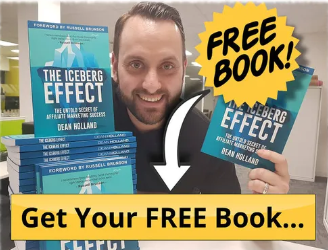
Today I’ve decided to include a short inspirational video from Dean Holland who wrote The Iceberg Effect and who is the main coach behind the Internet Profits Accelerator Partnership which I am a part of. Please enjoy the video and I think we can all take inspiration from his words.
Also, I appreciate the likes I’ve gotten for some of my articles! If you like my content, please go ahead and leave comments and share them on social media. Thanks!
I listened to The Iceberg Effect while driving. It was narrated by Dean himself and for this reason I felt like I started to get a connection to him personally.
In the beginning of the book Dean gives a bit of a story about his life. About how as a kid he grew up with a fascination for the finer things in life and how he wanted to grow up and be rich. About how he dropped out of high school at 16 and became a cook.
He was in the food industry until the time he started his first business. One day the lights came on inside as he realized he had all the contacts for wholesale and could start his own business.
I appreciated this look into his life, and it was even more real coming from the author himself in the audiobook. His next story was about a foray into the world of Internet Business. I related to this because I too had my own short lived internet business back in 2000. It went better for me and my partner however since, unlike Dean, we had our first sale in thirty days.
Dean continued to try to do business on the Internet but only ended up 40,000 pounds in debt without even having made his first sale.
Just as things were looking bleak, he had the fortune of replying to an email in time and being one of ten that would be getting a chance to hang out with Alex Jefferies, a successful internet entrepreneur. Dean was honest with Alex about his experience and nine months after joining Alex’s coaching program, he left his daytime job to become a full-time internet marketer.
I was glad to hear this upswing in the story because after all that failure and debt it seemed like Dean could use some relief. Things were looking up.
The book then starts to go into some of the mental aspects and planning in success. He will give some tips about how to get the mind in order, in order to be successful. I think these parts were very useful since it’s really about a winning mindset that gets you to the goal. There was an exercise about finding your why that I enjoyed and had never heard of before. All this pregame was useful stuff.
Then it gets into some of the technical details of affiliate marketing success and continues to explain the perfect path to seven figures.
First, Dean talks about the four core areas of focus. This was the nice way he organized the important areas to focus on if you are going to make big bucks in the affiliate marketing business. This explanation helps you set up and understand the game plan of capture pages. By referring to it over and over in its easy and concise explanation I think it will help you navigate difficulties.
Dean then explains the coming death of traditional affiliate marketing and goes on to explain the specific failures of this traditional model. I enjoyed this explanation and I also think it will be useful moving forward in affiliate marketing for anyone else reading or listening so they too can avoid the pitfalls.
To compensate for the changes that lead to the demise of the traditional model of affiliate marketing Dean developed the perfect path to seven figures.
I was all ears for this explanation as I too would love to join the ranks of the seven figure earners. I found the plan laid out clearly and concisely, easy to understand.
He explains that there are three distinct phases. Each phase is possible of mastery by any individual, but I appreciate the description of exactly where you should be financially before taking on each step. The phases are built up separately through time. If you want to get on the path, you should get a copy of the book.
Dean explains that unlike a normal job affiliate marketing can also provide you with MULTIPLE STREAMS OF INCOME.
He then tells an interesting story about how he began to work with Russel Brunson and how it led to the creation of the Ultimate Sales Funnel. The ultimate sales funnel is built on our prior knowledge of affiliate marketing and the four core areas of focus. This is the funnel you will be using on the path to seven figures.
CONCLUSION
The Iceberg Effect was short and concise. I really enjoyed learning about Dean’s past and prior failures. Learning that at the last moment he turned his life around was also exciting. It makes it seem like it could happen to anyone.
You are going to want to get a free copy of the book. The planning exercises will get you organized and ready to approach your dreams. The technical details will help you better understand the process and plan you are going to be on in affiliate marketing.
The book is a breezy fun read by someone who has had a meteoric rise to the top. Someone we can model and use as a reference if we want to do the same thing. Until next time…
Today I’d like to share with you the beginning of advertising for my website www.jonjamesbusiness.com.
I was reviewing videos on different forms of traffic. Of course, there are only two kinds of traffic: Free or Organic traffic and paid traffic. The number of different ways to get organic traffic were a bit overwhelming but I agreed that answering Quora questions and starting a blog, if nothing else seemed like a way to get my affiliate marketer persona established thereby providing value direct traffic to my website.
Since I had a certain budget, paid traffic also seemed to be quite alluring. However, I do remember from Dean Hollands initial training that as long as I don’t approach paid advertising with the mindset of “I’m paying for it, so it’s guaranteed to work,” I’ll be fine. As far as getting traffic I suppose it’s too easy to say: “Well I’ll pay for traffic for the first three months until the commissions start rolling in, then pay for traffic with the proceeds.” Better to make sure it’s really money I can afford to spend.
Since I am affiliate partner with internet profits my program included a great video about Facebook advertising by James Bertrand. This video was so easy to follow that I got started right away.
If you are not familiar with it there is a Facebook platform called Meta where you can make your own Facebook ad and run it daily. You can find the program at business.facebook.com, but you must have a Facebook business page to run it from.
In this case I designed a Facebook ad with an opt-in form. I decided for the picture to use the cover of my book Make Money Online – Avoiding the Pitfalls. I tell them: ‘Get this is you want THIS without the THAT.’ I then show a picture of the cover of my free eBook and tell you to get my free eBook by clicking the button. I know that this book will help them immensely.
The next ad form takes them to an opt-in form where they enter their name and email address. This will be added as a lead to my list of leads connected to my website. You can then link the leads added from your Facebook ad to your website lead list with programs like Make, or Zapier. Setting up the lead adding process was easy enough with Zapier, I didn’t find it anything to be afraid of technically.
The last ad form then lets you send a final message and a link button. I thank them and let them know that the eBook is on their way to their mailbox. The adding of a lead like this begins my email sequence and the first email is one that thanks them for their efforts then sends them to a page where they can access my eBook.
The link button on the final ad form is also up to you. It was recommended that you then link them to your blog or Facebook page or another value route. Since they are already visiting my webpage for the eBook, I decided to send them to someplace more useful.
In order to find the right interest keywords, I ran this ad multiple times with different keywords to find out which got the most hits. I couldn’t believe the success as there were multiple keywords that generated four leads.
I then rolled up all the working words into one ad and then, uh-oh, my ad pic got flagged for ‘get rich quick scheme’ reasons. I couldn’t believe, I even got an adrenaline rush (not a good one) like I had just done something bad. After relaxing for a moment, I checked it out and it just said to change the picture. I tried not to take it personally, but I couldn’t believe that multiple iterations of the ad had gone from processing to running without incident only to have this final one get stopped. I was hoping to run this ad as is for a while since it was already working out.
Oh well, I thought and then proceed to work on a new one. I went ahead and submitted this one in the afternoon, came back the next afternoon excited to see it adding more leads when I was devastated: my account was now on hold.
My account on hold? This was just as disturbing as the night before and made those fear of failure feelings well up. I answered a survey about how they did in relation to the response and let them know that the little information they had provided was not good. Suddenly I couldn’t access my account, or the meta platform had kind of frozen. I decided to give it up for the night and try again tomorrow. I can tell you that it’s not easy to run into these kinds of issues at the beginning and it made me feel anxious like I wasn’t going to be able to advertise on Facebook anymore (the dreaded Facebook jail).
The next day I decided to go ahead and assess the damage. After Meta froze it looked like my account reset, I no longer had a list of two failures with one failed challenge to an ad. When I dug further to see my account status, I saw that Meta just needed to verify my identity. “Thanks goodness maybe I wasn’t banned Afterall!” I thought. I felt so much better. Verifying my identity took less than an hour after submission, a piece of cake. Maybe Meta was just worried I was a bot or something and that’s where the trouble started.
I got my new ad running and it’s off to a great start. Until next time in the future when I get my ad critiqued by pros.
CONCLUSION
Facebook ads are easy to set up and help you make a professional looking ad in no time. It reaches your desired interested groups, and you can choose on how much a day you want to spend. Make sure your ad is original and you don’t cross any lines when it comes to rules, or you might get blocked. My ad was only running for three days, and I got eighteen leads! For now, I have nothing to report in the way of the pitfalls of Facebook ads.
This is the free gift you get when you enter your name and email address at my website jonjamesbusiness.com
This book first warns you about the riskiness of trying to make money on the internet. It points out that there are a lot of ways to make money on the internet like amazon or fiverr, but understands that the person reading the book is most likely to be thinking about the bigger picture of business. It’s important to point out to readers that if they want help succeeding its better to approach it from this perspective, as starting a business.
Next, Pitfalls discusses that starting a business online is more like a journey. However, making the map for that journey can be troublesome because of all the excess information and systems found available on the internet (think ‘get rich quick’ garbage). With all this information it can be difficult to discern and filter out what they don’t need.
The book explains that an online business, by its very nature, is a technical business. There will be certain things that, at some point to other, you will have to learn about, buy and use.
Pitfalls takes a look at some of the things that you will need at some point or other and will need to buy, learn about or both, like graphics, video editing, and a page builders (we talked about Builderall, the page builder, last post). It explains that there is also the necessity of some technical training needed for certain elements like graphics, audio/video editing, documents and maybe even some coding (or at least reading the code behind things like embedded video). You don’t necessarily even need to be an expert in any of these particular aspects, but you should at least know something. Pitfalls explains that thing to bear in mind is that understanding a bit of the background when things go wrong helps being able to spot the problem and maybe even fix it.
Rather than going out and grabbing things to build their business with the above in mind, Pitfalls then explains that we need to see ourselves as a general contractor making a plan on a project. The key to building out or plan is building out our trade in order to finish the plan.
For example, let’s say you want to be an affiliate marketer. Ask yourself: “What do I need for affiliate marketing right now?” There are lots of things that you could focus your attention on, but are they in any way relevant to what you’re doing right now?
Pitfalls then can explain that the project is always the decider of whether you need to buy a new tools or training which is usually the next step people go out and jump into. This leads to the pitfalls of buying stuff, stuff you don’t need. If you’re not going to use it don’t get it. It tells them to imagine they’re working through a project, and they hit a brick wall. They’ll realize that in order to get past it, they will only need the software/training/service they right now need to move along to completion.
The book then explains, as in the above example, affiliate marketing can be a great place to start.
CONCLUSION
Making Money Online Avoiding the Pitfalls first brings the focus of the reader onto the bigger picture. It explains that online business involves technical skill and knowledge in order to move along. By stepping back and seeing it as a contractor working on a project the readers can see the path they need to completion. At every step this helps them know which product, service or software they need next to get to the next step. Then in the end it reiterates that affiliate marketing can be a great first opportunity stating:
‘Affiliate marketing probably has one of the lowest barriers of entry to making money online legitimately and consistently…Affiliate marketing still works and can be extremely profitable.’
Okay, so I’ve started with the affiliate program for internet profits. After about two day’s worth of learning all about affiliate marketing I’m now a certified partner with my official certification and everything.
The next step is to get an opt-in started. In affiliate marketing this is a simple website that directs potential leads to enter their information, in my case email and name, which is added to an email list in return for value. In this case the value I’m offering them is Making Money Online – Avoiding the Pitfalls. The software I’m using to set this up is BuilderAll. Since I used the Quick Start Challenge this software is familiar to me. BuilderAll also includes MailingBoss software which will help set up mailing campaigns. My opt-in website is setup and ready to add leads to my email list.
Overall I see these first steps as a relatively positive experience. Dean Holland talks about issues to moving forward especially as fears. The fear: what if it doesn’t work? The fear: What if it works? These must be something facing all new business starters or affiliate marketers and I’m glad that he mentioned them. Now, when I feel that uncomfortable feeling welling up to ward me away from my laptop I can just simply name it: Fear of Failure, Fear of Success, or whatever it my be and move on.

















 Jon James Affiliate Successes